
Ahead of World Tuberculosis (TB) Day, the Global Fund Advocates Network Asia-Pacific (GFAN AP), Asia-Pacific Regional Learning Hub (APRLH), Activists’ Coalition on TB – Asia-Pacific (ACT! AP), Global Coalition of TB Advocates (GCTA), Stop TB Partnership, TBPeople, and Younite Global jointly hosted a special discussion session titled “Ending TB: Overcoming Political and Financial Hurdles in the Asia-Pacific” on 13 March 2026.
The call brought together diverse perspectives to foster knowledge sharing and collective joint action, with the objectives to:
- Provide updates from an Asia-Pacific perspective on key expectations for Global Fund Grant Cycle 8 (GC8) TB programming, including sustainability, co-financing requirements, and the role of Country Coordinating Mechanisms (CCMs).
- Examine the implications of Global Fund Replenishment outcomes on TB communities and civil society in the Asia-Pacific region, particularly in relation to funding availability and program continuity.
- Facilitate collective strategising among participants on priority collaborations, advocacy approaches, and coordinated actions needed to strengthen donor engagement, mobilise additional resources, and support pledge conversions.
The webinar discussion was attended by approximately 60 participants and was moderated by Jennifer Ho (Operations and Program Manager, GFAN AP). The session opened with introductions and brief welcome remarks by the co-organising team.
1. Keynote address
Lucica Ditiu (Executive Director, Stop TB Partnership) delivered the keynote address, providing background to the discussion and highlighting a number of key points:
- TB remains the world’s biggest infectious disease killer and an airborne threat to everyone, yet has historically been underfunded relative to its global impact and burden.
- The Global Fund’s Grant Cycle (GC) 8 arrives during a period of deep economic shifts and competing priorities, resulting in less funding than GC7.
- Despite lower funding, new tools like mobile X-rays, artificial intelligence (AI), and near-point-of-care diagnostics offer chances for increased efficiency.
- Concerningly, investments in civil society may disappear as countries prioritise commodity procurement. During this time, it is important that communities and civil society increase direct engagement with Country Coordinating Mechanisms (CCMs).
- Several Asia-Pacific countries are approaching a transition away from Global Fund support, risking the total disappearance of civil society funding if not sustained domestically.
2. Overview of TB in the context of GC8
James Malar (Community Engagement, Capacity Building and Stigma Reduction Coordinator, Stop TB Partnership) presented a detailed overview of the fight against TB in the Asia Pacific in the context of GC8 as well as key risks, challenges and asks from communities:
- Asia Pacific holds over three-quarters of the global TB burden, 60% of global TB deaths, and the majority of missing people with TB and multi-drug resistant TB (MDR-TB) globally.
- Colleagues are urged to use Stop TB Partnership’s Tuberculosis Dashboard to access and utilise country and regional data when conducting community engagement, defining country-level priorities, briefing and advocating to CCMs, and crafting priorities in funding requests.
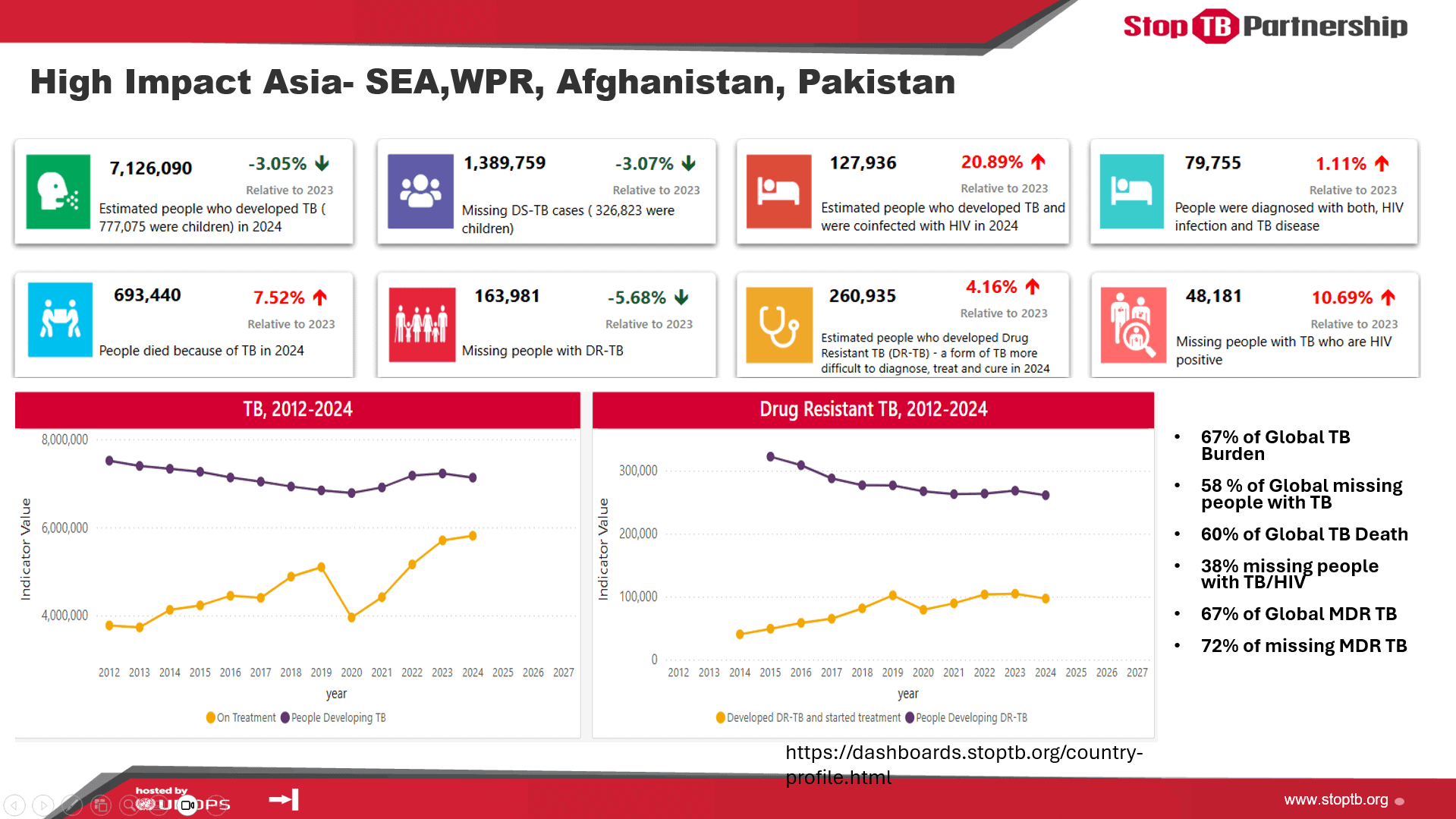
- While progress is real with declines in TB incidence and mortality, and expansions in diagnostics and TB preventative therapy (TPT), significant gaps remain as TB incidence, mortality, social protection, and financing are well below targets and off-track to the 2025 UN High-Level Meeting (HLM) TB goals.
- Barriers to ending TB include severe funding challenges, inadequate access to diagnosis & care, inadequate social protection, limited case detection and diagnostic coverage, stigma and persistent structural and social determinants, systemic health and community service constraints, slow scale‑up of preventive treatment, and challenges with drug resistance.
- For the first time, Stop TB Partnership has data from 22 countries which provide evidence on where stigma occurs in the patient journey, which should be used to target GC8 interventions.
- TPT must continue to be prioritised in Global Fund discussions and communities have an important role to play in demand creation for new DR-TB tools.
- TB receives 18% of Global Fund allocations and TB communities are underrepresented and under-resourced in CCMs; CCMs can revisit funding allocations to ensure a more equitable share for TB.
- The Challenge Facility for Civil Society (CFCS) is focused on four main pillars:
- Address Stigma, Social and Structural Barriers
- Close Gaps in TB Case Detection, Prevention and Treatment, and Demand Creation
- Scale Up ONEIMPACT Community-led Monitoring (CLM)
- Invest in TB-Affected Communities and Community Systems
- 11 grantees under CFCS are in the Asia Pacific, with impact in Cambodia, India, Indonesia, Pakistan, the Philippines and Vietnam among other countries.
- Communities are asked to share access to updated information when received, deepen engagement in country processes to ensure inclusion of community priorities, build on past and current TB community investments, and to make use of the evidence base (stigma assessments, community, rights & gender assessments, key & vulnerable populations size estimations, CLM) built by CFCS partners.
- Other useful links: TB Stigma Portal and OneImpact Dashboard.
3. Outcomes of the Eighth Replenishment, Decisions on Country Allocations & Catalytic Investments and Advocacy Areas
Rachel Ong (Regional Coordinator, GFAN AP) presented on the outcomes of the Eighth Replenishment, the sources and uses of funds for the 2026-2028 GC8 allocation, and catalytic investments for 2026-2028:
- To date, US$12.6 billion has been pledged to the Global Fund Eighth Replenishment, with . significant drops seen from some donors. A number of donors including France, the European Commission (EC), and Indonesia from the Asia Pacific region have also yet to pledge. At the same time, some donors such as India and South Korea have stepped up or sustained their commitments despite current challenges.
- US$10.8 billion has been set for country allocations (after deducting operating expenses and other costs) resulting in country allocations for GC8 to be approximately 9% lower than GC7.
- US$774 million is available for catalytic investments, which includes next-gen market shaping, emergency funds, addressing human rights and gender barriers, building community networks and engagement, supporting sustainability and transitioning, optimising RSSH, as well as climate and health. More specifically, US$70 million is allocated in catalytic investments for addressing human rights and gender barriers.
- With reduced resources, some countries are expected to face accelerated transitioning, with GC8 expected to be their final grant and significantly reduced resources for Asia-Pacific communities and civil society.
Ken Khoo (Communications Officer, GFAN AP) introduced and presented an Asia-Pacific-led TB advocacy video which highlights the lived experiences of TB survivors and the impact of funding cuts. Special thanks were noted to the speakers and partners who contributed input and provided multilingual subtitle support.
Next, Aman Shukla (Chair & Founder, Younite Global) presented on behalf of TBPeople, highlighting resource challenges faced by TB communities worldwide:
- Community networks support people through diagnosis and treatment, reduce stigma and discrimination, and collect data about barriers to care to ensure that programmes respond to the real needs of the community.
- However, many TB community organisations face threats of sustainability as they receive less than US$25,000 annually, with TB survivor networks receiving the least compared to other diseases.
- Challenges also include a lack of administrative capacity among smaller organisations to navigate funders’ processes, short-term funding cycles threatening sustainability and eroding trust in community programmes, and the limited access of communities to decision-making spaces.
- Attendees are invited to sign a petition calling for the Global Fund Board to protect community-led mechanisms such as CFCS.
4. Plenary Discussion on Priorities and Areas of Collaboration
Atul Shendge (Program Officer, GCTA) moderated a brief plenary discussion, inviting speakers to share their top priorities and/or challenges as well as any reflections on what is needed to sustain community-led responses and strengthen resource mobilisation.
- Blessi Kumar (CEO, GCTA) noted that the primary challenges identified by communities are stigma and a lack of awareness, and stressed that AI and technology are useless if communities lack the capacity and if stigma remains unaddressed.
- Leslie Bola (ACT! AP) highlighted a 20% loss-to-follow-up rate in PNG and advocated for prioritisation of CLM to improve service quality, as well as the strengthening of survivor groups, which are essential for reducing stigma and improving treatment adherence.
- Aman Shukla called for youth to be recognised as key partners rather than mere beneficiaries in grant planning and monitoring processes, noting that TB youth networks lack dedicated resources for awareness and stigma reduction.
- Chinmy Kumar (Coordinator, APRLH) stressed the importance of breaking down silos to ensure a unified regional response and the need to build technical literacy in communities to empower effective negotiations with CCMs, urging communities to reach out to CCMs immediately to negotiate domestic financing for diagnostics and treatment.
5. Closing
Rachel Ong concluded the webinar discussion with a call for a shift from reactive donor reliance to holding governments accountable for sustainable domestic health financing through tax collection. The session closed with warm appreciation to all attendees for their participation, advocacy and solidarity.
PRESENTERS:

James Malar
Community Engagement, Capacity Building and Stigma Reduction Coordinator, Stop TB Partnership

Rachel Ong
Regional Coordinator, Global Fund Advocates Network Asia-Pacific

Ken Khoo
Communications Officer, Global Fund Advocates Network Asia-Pacific


Lesley Bola
Executive Director, Key Population Advocacy Consortium Papua New Guinea

PRESENTATIONS:
-
- TB in the Asia Pacific. Presenter: James Malar, Stop TB Partnership.
- Eighth Replenishment Decisions for Allocations and Impacts on Communities & Civil Society. Presenter: Rachel Ong, Global Fund Advocates Network Asia-Pacific.
- Support Strong Global Fund Funding. Presenter: Aman Shukla, Younite Global.