As the Republic of Korea prepares to host the G20 in 2028, its growing role in global health financing and governance offers an opportunity to advance health equity through ODA and development cooperation. Drawing on the October 2026 Bangkok civil society convening, this blog explores how GFAN AP and its partners can bring community priorities into Korea’s G20 preparations, strengthen coordinated advocacy across 2027 and build momentum towards a fully resourced Ninth Replenishment of the Global Fund in 2028.
The Republic of Korea’s 2028 G20 presidency presents an opportunity to strengthen political commitment to equitable health financing and community-led responses across Asia-Pacific given the accelerated transitioning of countries from Global Fund funding. With the Ninth Replenishment of the Global Fund to Fight AIDS, Tuberculosis and Malaria (Global Fund) anticipated in teh same year, partnerships developed now could help connect international economic discussions with the resources needed to end HIV, tuberculosis (TB), malaria and build resilient and sustainable health and community systems to achieve Universal Health Coverage (UHC).
Korea brings growing financial and governance responsibilities to these discussions. Its increased Global Fund pledges, participation alongside Japan in a voting donor constituency on the Global Fund Board, and engagement across other multilateral health institutions provide several avenues for dialogue with communities and civil society. For GFAN AP and partners, the opportunity is to connect these roles with a shared ambition, sustained investment that reaches people, protects rights and strengthens community leadership.
Korea’s growing investment in the Global Fund
Korea’s support for the Global Fund has expanded considerably over time from 2001 when Korea first pledged US$750,000. Cumulatively, Korea as pledge KRW 8.34 billion and US$262.82 million. The Seventh Replenishment marked a major step forward, with Korea quadrupling its pledge from US$25 million to US$100 million. It maintained the US$100 million pledge for the Eighth Replenishment and has already contributed US$30 million against the latest pledge (as of 9 November 2026).
It is therefore important to sustain public and parliamentary support for the Global Fund, communicating the impact of Korea’s investment, and building ambition towards the Ninth Replenishment.
Connecting Korea’s wider multilateral health roles
Korea’s influence extend across several institutions relevant to health financing, access and international cooperation:
-
- WHO: Korea’s Executive Board term runs from May 2024 to May 2027, providing an avenue for engagement on health policy and preparations for the World Health Assembly.
- Unitaid: Korea holds an Executive Board seat and participates in its Policy and Strategy Committee. These roles offer connections to discussions on innovation, affordability and access to health products.
- Gavi: Korea belongs to the shared donor constituency comprising Germany, Australia, Ireland and Luxembourg. Its participation provides another setting for dialogue on equitable access and sustainable health investment.
- The Pandemic Fund: Korea participates in the Japan-Australia-Korea-Singapore contributor constituency. Korea is a founding financial contributor and its representation through its finance ministry creates an avenue for connecting health investment with international finance discussions.
Together with Korea’s forthcoming G20 presidency, these roles offer opportunities for partners to encourage consistent support for equitable access, meaningful community engagement and sustainable financing across institutions. Joint advocacy could highlight how investments in the Global Fund contributes to stronger health systems while protecting the specific services and rights of affected communities.
Connecting health with the wider civil society agenda
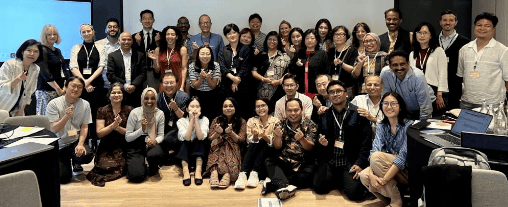
At the Asia Civil Society Strategy Convening: Influencing the Republic of Korea’s 2028 G20 Presidency in Bangkok on 10-11 October 2025, organised by Oxfam and the C20 Korea Platform, participants explored how civil society could contribute to Korea’s G20 preparations. Discussions addressed inequality, debt, taxation, climate justice, digital governance and civil participation.
These themes connect with the conditions that shape health financing and access to care. Collaboration between community networks, health advocates and organisations working on debt and public finance could help demonstrate how fiscal pressures affect prevention, treatment and support services.
Such evidence could inform dialogue on domestic financing commitments that reflect countries’ capacity and protect continuity of care. It could also strengthen the case for sustained international grant financing alongside domestic investment.
This further builds on the work with partners and discussions on solidarity levies and innovative financing, exploring how additional public revenue can support equitable health investment, as well as discussions and advocacy for increased debt to health swaps for debt conversion. Across these discussions, community participation can help keep attention on whether resources reach people facing the greatest barriers to services.
Building connections across 2027
Regional and global platforms in 2027 offer important avenues for partners to build support for health equity ahead of Korea’s 2028 G20 presidency. Bringing community experiences into these discussions can demonstrate how decisions on ODA, debt, domestic financing and development cooperation affect access to HIV, TB and malaria services. Joint contributions could connect these experiences with concrete proposals for Korea’s G20 agenda, including sustainable health financing, protection from financial hardship, equitable access to health technologies and meaningful community representation and participation.
These platforms also create opportunities to build alliances beyond the health sector and engage Korean officials, parliamentarians, researchers and civil society partners while presidency priorities are taking shape. Coordinating advocacy across meetings could help partners develop shared proposals and carry them into dialogue with Korea’s G20 representatives and the officials leading finance and health discussions. Linking this work with GFAN AP partners on the Korea C20 working group will strengthen continuity through 2027, helping position health equity as a shared economic and development priority for Korea’s presidency and build political support for a fully resourced Global Fund towards the anticipated Ninth Replenishment of the Global Fund in 2028.
Looking ahead to Seoul: Bridging shared priorities together
The Bangkok convening envisaged a follow-up civil society gathering in Seoul in 2027 to develop concrete policy proposals and coordinated advocacy towards Korea’s G20 presidency. For GFAN AP, the proposed convening could connect with broader areas and discussions of work:
-
- Strengthening support for a fully resourced Global Fund. Partners could explore common messages on the value of sustained international financing and Korea’s contribution to the Global Fund partnership., Engagement with Korean ciivl society, parliamentarians and government representatives could connect replenishment advocacy with Korea’s G20 preparations and its governance role alongside Japan.
- Advancing sustainable and equitable domestic financing. Community networks and public-finance advocates could bring country evidence on how debt, budget pressures and financing transitions affect services. Joint proposals could address realistic domestic financing commitments, protection of essential programmes and accountability for health spending.
- Protecting community leadership, rights and inclusion within UHC. Partners could identify shared priorities for financing community-led responses, community-led monitoring and advocacy and ensuring that people affected by HIV, TB and malaria help shape health policy. Evidence could highlight barriers related to discrimination, gender inequality and out-of-pocket costs, supporting advocacy for UHC that responds to underserved communities.
Depending on its timing, the Seoul gathering could draw on evidence and relationships developed through the 2027 platforms or help shape subsequent contributions. Coordination with UK civil society partners could also support continuity between the UK’s 2027 G20 presidency and Korea’s presidency in 2028. But the emphasis would be to bring these conversations into the UK G20 presidency in 2027 which would be carried over to 2028.
For GFAN AP, the Bangkok convening reinforced the importance of bringing health equity and community leadership into the economic and development decisions that shape resources for HIV, TB and malaria responses. Our involvement going forward can help connect community experience with these wider policy discussions, share evidence across networks and coordinate advocacy with Korean, regional and global partners. By facilitating exchanges, developing shared priorities and sustaining dialogue amongst GFAN AP partners towards Korea’s G20 presidency, GFAN AP can help build collective momentum for the anticipated Ninth Replenishment in 2028. This work is central to our commitment to a fully resourced Global Fund: building partnerships and political support needed to turn pledges into sustained investment that reaches communities, protects rights and advances equitable access to health.
MEETING REPORT:
PRESENTATIONS:
-
- Introduction on G20
- Fix the System
- Signals from Korean Government over the 2028 Korean G20 Presidency
- Reflection and Suggestions about G20/C20
- What South Africa’s G20 taught us, and a tip for Korea 2028
- South Korea as a bridge country
- The 2026 US G20 Presidency: Lessons, challenges, and the road ahead