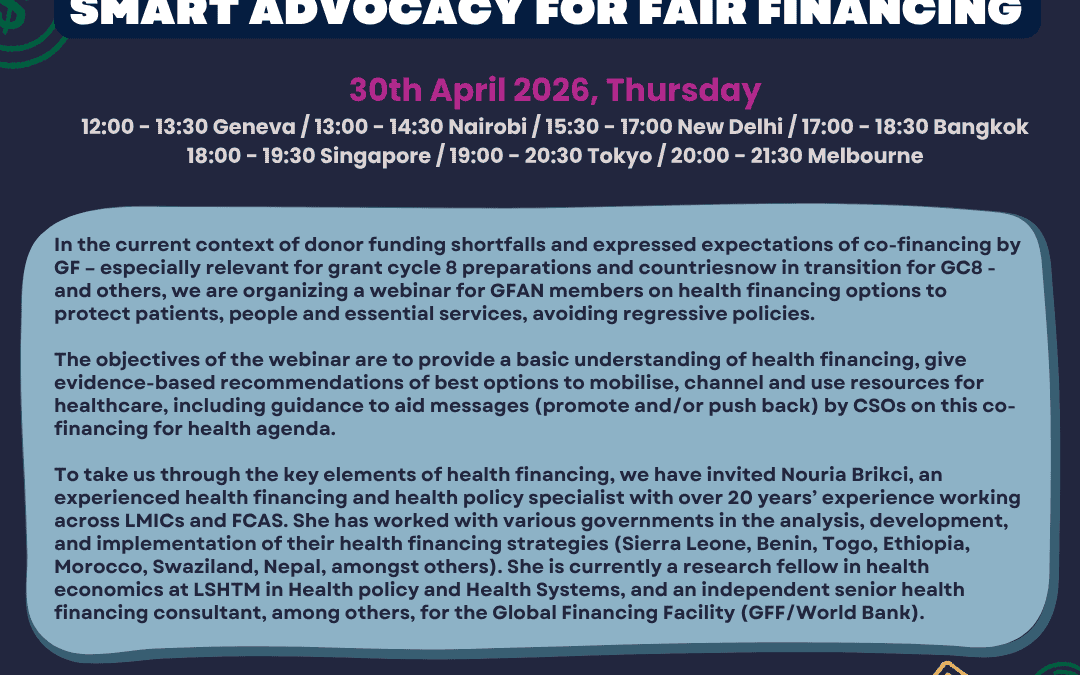
The Global Fund Advocates Network Asia-Pacific (GFAN AP) and GFAN Africa, GFAN and Medecins Sans Frontieres (MSF) jointly hosted “Global Fund Grant Cycle 8 in Focus: Smart Advocacy for Fair Financing” on 30 April 2026. The webinar was joined by over 70 participants and focused on health financing and domestic resource mobilisation (DRM) in the context of Global Fund transitions and to strengthen communities and civil society capacity for engaging in Grant Cycle 8 (GC8) funding dialogues amidst significant aid disruptions and a rapidly changing health financing and development landscape.
The webinar set out to:
- Provide participants with information and evidence from real life health financing options and their positive/negative effects.
- Build leverage – access to peer reviewed documents, capacity and confidence of participants in negotiation during Global Fund grant proposal processes.
- Reflection on and exploration of key elements for strategic CSO advocacy against damaging options and in favour of beneficial/protective financing options.
1. Health Financing and Resource Mobilisation
Nouria Brikci, an experienced health financing and health policy specialist with over 20 years’ experience across LMICs and FCAs from the London School of Tropical Medicine and Hygiene provided a presentation which explored the implications of various financial options to meeting co-financing requirements and their inevitable implications and impacts on the communities. She provided the realities of health financing fundamentals, emphasising that rapid DRM within three-year Global Fund allocation cycles is unrealistic for many LMICs.
Nouria presented on health financing concepts, focusing on the three core functions of health financing:
- Revenue Mobilisation: Raising funds through taxation, insurance, donor grants (not out-of-pocket payments, which are inefficient and harm access)
- Pooling: Bringing resources together to enable cross-subsidisation between rich/poor and healthy/sick populations, essential for financial protection
- Purchasing: Deciding what services to buy, from whom, and using which provider payment mechanisms
Nouria also discussed the three dimensions of the UHC cube:
- Population Coverage: Who is protected
- Service Coverage: Which services are in the benefit package
- Financial Protection: Reducing out-of-pocket payments through prepayment mechanisms
Nouria explained the concept of progressive universalism which is to start with the most vulnerable and worst-off populations, prioritising services for vulnerable groups and limit out-of-pocket payments. She concluded by explaining the public finance management and budget cycle, noting the need for civil society to understand these systems and processes to effectively advocate for sustainable health financing that meets the needs of communities.
Nouria further discussed health financing approaches and the challenges of transitioning away from donor funding. She explained the importance of strategic purchasing and various solutions for creating fiscal space, including taxation, social health insurance, and debt relief. Nuria emphasised that while domestic resource mobilisation is crucial, these solutions are complex and time-consuming, and civil society should advocate for realistic timelines and benchmarks. She pointed out some feasible approaches (with caveats):
- General Taxation: Most suitable but difficult for the health sector to influence directly; tax-to-GDP ratios remain low in many countries
- Health Taxes: Politically acceptable taxes on tobacco, alcohol, sugar-sweetened beverages, CO2 emissions; raise maximum 0.5% of GDP – useful entry point but not the solution
- Social Health Insurance: Supports prepayment and pooling but meet with great challenges especially in countries where 90% of the population may be in the informal sector; expensive to set up and requires time
- Debt Relief: An important instrument where there are high debt-to-GDP ratios, but debt-to-health swaps require scrutiny as they often result in consolidation rather than true relief
- Efficiency Gains: 40% of health resources are wasted globally, but address inefficiencies involve political settlements and technical complexity – not overnight fixes
Nouria suggested the following key benchmarks for advocacy efforts:
- Minimum spend of US$60 per person per year for UHC (less than one-third of low-income countries meet this benchmark)
- 5% of GDP allocated to health (most effective comparative benchmark)
- 50% of resources to primary health care
- Less than 20% of total health spending from out-of-pocket payments
- 15% of national budget to health (as with the Abuja Declaration)
Nouria concluded by stressing that the most effective advocacy approach would be to cost the benefit package to demonstrate the gap between needs and available resources, rather than relying solely on global benchmarks. She also pointed out that earmarking health taxes could fragment systems and limit government flexibility; the better approach would be to integrate the diseases into national benefit packages to show resource gaps.
2. Civil Society Advocacy Priorities for GC8
Tess Hewett, Global Fund Focal Point (all sections) & Health Policy Advisor (MSF Belgium) presented on the essential role of communities and civil society in the Global Fund grant cycle, emphasising the need to push back against co-financing requirements and DRM in certain contexts where they may not be feasible or realistic as follows:
- Out-of-pocket payments are not DRM: must be resisted immediately if proposed
- Unrealistic transition timelines: challenge rapid co-financing requirements in fragile/conflict states and countries lacking fiscal capacity
- HIV/TB transition risks: The GC8 portfolio is heavily weighted towards HIV/TB transition; putting 20 years of progress at risk for countries that are Global Fund dependent for TB responses
The role of communities and civil society organisations are not only to hold governments accountable, they provide valuable insights into local needs, particularly in countries transitioning in GC8. Key strategic engagement processes/areas for communities and civil society to note are as follows:
- Understand public finance management (PFM) and budget cycles; budget formulation, execution and monitoring
- Track budget execution gaps: Ministries of Finance may refuse additional allocations if existing budgets are underspent due to FPM blockages, which is often the responsibility of the Ministry of Finance and not the Ministry of Health
- Demand budget transparency: This is essential for holding decision-makers accountable
- Protect funding for key populations and vulnerable groups: Integration into general health systems risks losing targeted services for stigmatised/marginalised communities
- Advocate for specific health interventions in benefit packages rather than disease-specific earmarking which fragments systems
3. Discussion
The session included extensive Q&A where participants discussed practical examples from countries like Zimbabwe with the Zimbabwe AIDS levy established through Act of Parliament, ring-fenced and goes directly to the National AIDS Council Trust Fund. Other health taxes (mobile phone levy, sugar tax, fast food tax) not ring-fenced and the funds go towards consolidated revenue fund, making tracking impossible. Moreover, the Ministry of Finance and industry report vastly different collection figures. Other countries with emerging earmarked financing include Tanzania which is moving toward earmarked health resources following funding cuts; Zimbabwe advancing National AIDS Trust Fund discussions; Malawi allocating 2% for primary health care facilities in recent budget (a decision that would need to return to Parliament); and Burundi with specific pooled funds with donors and World Bank to finance free care for children under five.
Discussions were also held around the challenges of tax implementation and earmarking, with Nouria emphasising the importance of integrating health interventions into national benefit packages rather than pursuing fragmented approaches through specific disease-focused taxes. Nuria also emphasised the importance of considering trade-offs between earmarking and government flexibility in resource allocation.
The call concluded with warm appreciation to all the participants and speakers and a call to engage actively in the country dialogues to ensure that the data from allocation letters support identifying gaps early to position for additional Global Fund resources when available.
PRESENTERS:


PRESENTATIONS:
- Global Fund Financing Issues: Global Fund Grant Cycle 8. Presenter(s): Nouria Brikci, London School of Hygiene and Tropical Medicine; Tess Hewett, Doctors without Borders.