Statement
GFAN AP welcomes Dr Mark Dybul as
incoming Global Fund Executive Director
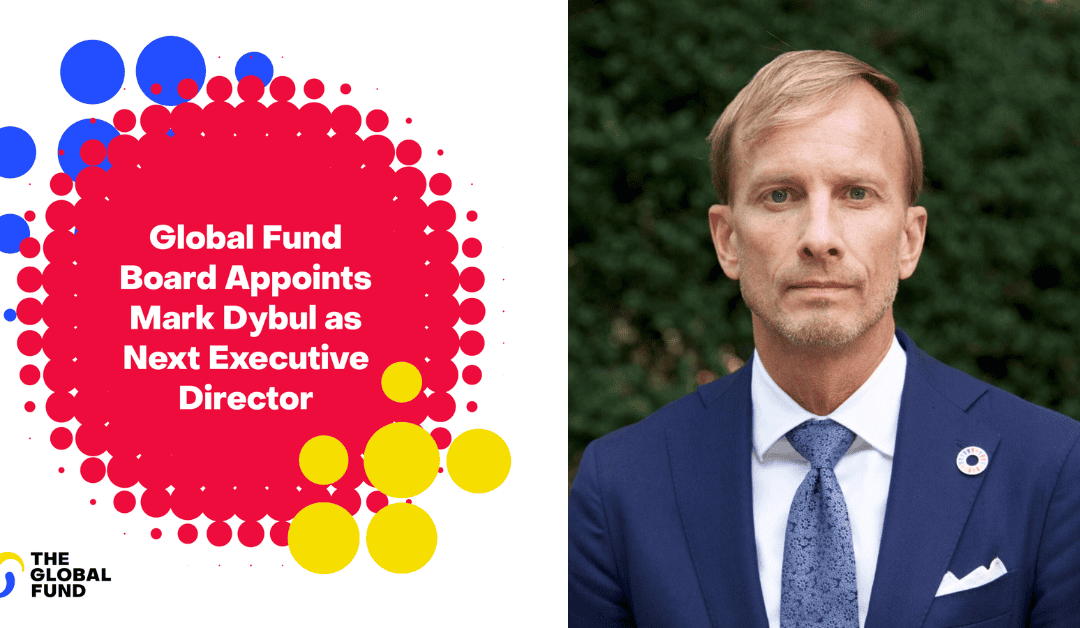
Global Fund Advocates Network Asia-Pacific (GFAN AP) welcomes the appointment of Dr Mark Dybul as the next Executive Director of the Global Fund to Fight AIDS, Tuberculosis and Malaria (Global Fund). As he prepares to begin his term in early 2027, GFAN AP urges him and the new Board leadership to act decisively to protect human rights, sustain community-led responses and close financing gaps. Protecting hard-won gains and ending the three diseases as epidemics require leadership that puts the needs and rights of affected people at the heart of every decision.
GFAN AP expresses its sincere appreciation to Peter Sands for his leadership since 2018, including through the COVID-19 pandemic, his commitment to mobilising resources and his efforts to advance access to lifesaving innovations during challenging times for global health. We thank him for his dedication to the Global Fund’s mission and for championing sustained investment in the fight against HIV, TB and malaria.
GFAN AP warmly thanks outgoing Board Chair Lady Roslyn Morauta and Vice-Chair Bience Gawanas for their stewardship and commitment to keeping people at the centre of the partnership during a challenging period for global health. We welcome incoming Chair Erna Solberg and Vice-Chair Javier Hourcade Bellocq and call on them to uphold an inclusive, accountable partnership in which communities and implementing countries have meaningful influence over decisions, resources and the future of the Global Fund.
Dr Dybul returns with experience of the Global Fund’s partnership model at a time when funding pressures, disrupted external assistance and transitions from Global Fund support threaten service continuity and community-led responses across Asia-Pacific. Budget reductions must not strip away the community organisations and systems that connect people to prevention, diagnosis, treatment and care. Sustainability must extend beyond service delivery to protect organisational capacity, independent advocacy, leadership development and the ability to hold institutions accountable. This requires long-term support for core operations and networks, alongside active protection of civic space. Financial constraints must not become a justification for weakening human rights commitments or excluding communities from decisions.
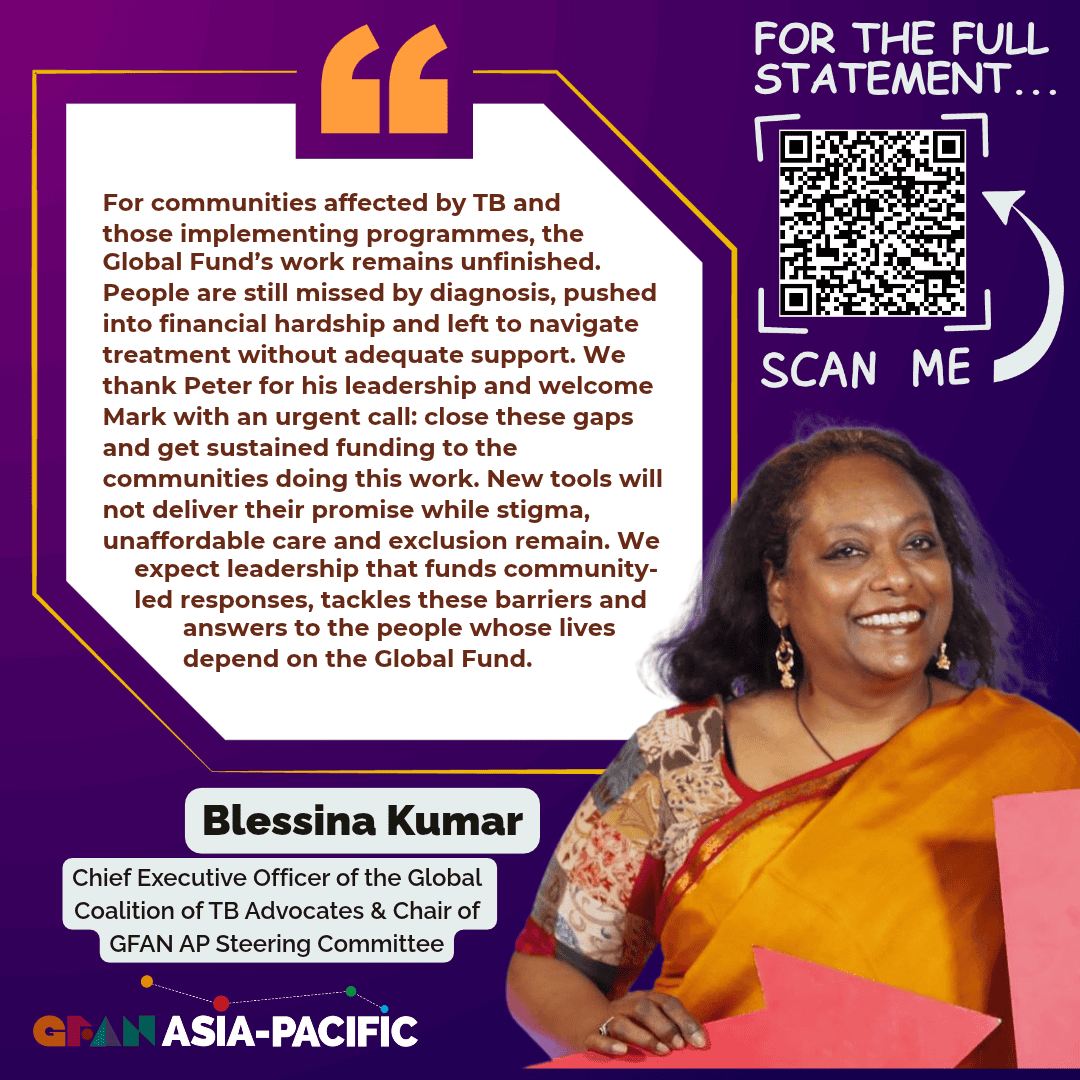
“For communities affected by TB and those implementing programmes, the Global Fund’s work remains unfinished. People are still missed by diagnosis, pushed into financial hardship and left to navigate treatment without adequate support. We thank Peter for his leadership and welcome Mark with an urgent call: close these gaps and get sustained funding to the communities doing this work. New tools will not deliver their promise while stigma, unaffordable care and exclusion remain. We expect leadership that funds community-led responses, tackles these barriers and answers to the people whose lives depend on the Global Fund,” said Blessi Kumar, Chief Executive Officer of the Global Coalition of TB Advocates (GCTA) and Chair of GFAN AP Steering Committee.
GFAN AP calls on the incoming Executive Director and Board leadership to act urgently on five priorities during their tenure:
- Close financing gaps and deliver predictable resources. Press existing donors to honour and convert their pledges into contributions, secure increased commitments and expand the donor base. Work with countries to increase equitable domestic investment in health and demonstrate that committed funds reach programmes and communities. Advance additional financing through mechanisms such as Debt2Health and progressive solidarity levies, with transparent allocation and public accountability. Additional mechanisms must complement sustained public financing and donor commitments.
- Prevent unsafe transitions and protect access to care. Reject transition timetables and co-financing expectations that outpace countries’ fiscal capacity or ability to sustain inclusive services. Require costed, community-informed plans with verifiable safeguards for service continuity, human rights and financing for community-led organisations before support is withdrawn. Review and adjust transitions when these safeguards are not met. Secure workable domestic funding mechanisms, including appropriate social contracting arrangements. Do not shift financing gaps onto people through user fees or increased out-of-pocket payments, or allow national income classifications to obscure exclusion and unmet need.
- Put resources and decision-making power in community hands. Expand direct, accessible and predictable funding for community-led organisations, including core costs, independent advocacy, leadership development and community-led monitoring. Require meaningful, resourced community participation throughout funding requests, grant-making, implementation and oversight, with transparent responses to community priorities. Simplify funding requirements that exclude smaller organisations and protect independent voices from intimidation or retaliation. Report on how funding reaches community-led organisations and how their evidence changes decisions.
- Defend human rights and gender equality without retreat. Protect funding to address stigma, discrimination, criminalisation and gender-related barriers when grants are reprioritised. Use the Global Fund’s influence to challenge laws, policies and practices that obstruct access to services or endanger communities. Hold programmes accountable for reaching key populations, women and girls, young people and underserved communities with quality care. Protect civic space and community advocates, and ensure safe, accessible mechanisms to report exclusion and rights violations and obtain a response.
- Guarantee service continuity through crises and protect the disease responses. Act rapidly to prevent treatment interruptions and loss of prevention services during conflict, displacement and climate-related disasters. Require contingency plans that are developed with communities and reach migrants, refugees, displaced and stateless people. Strengthen integrated primary care, mental health and community systems while preserving the expertise and services needed to end HIV, TB and malaria. Global health reforms and integration into universal health coverage must preserve access for people whose needs are routinely overlooked.
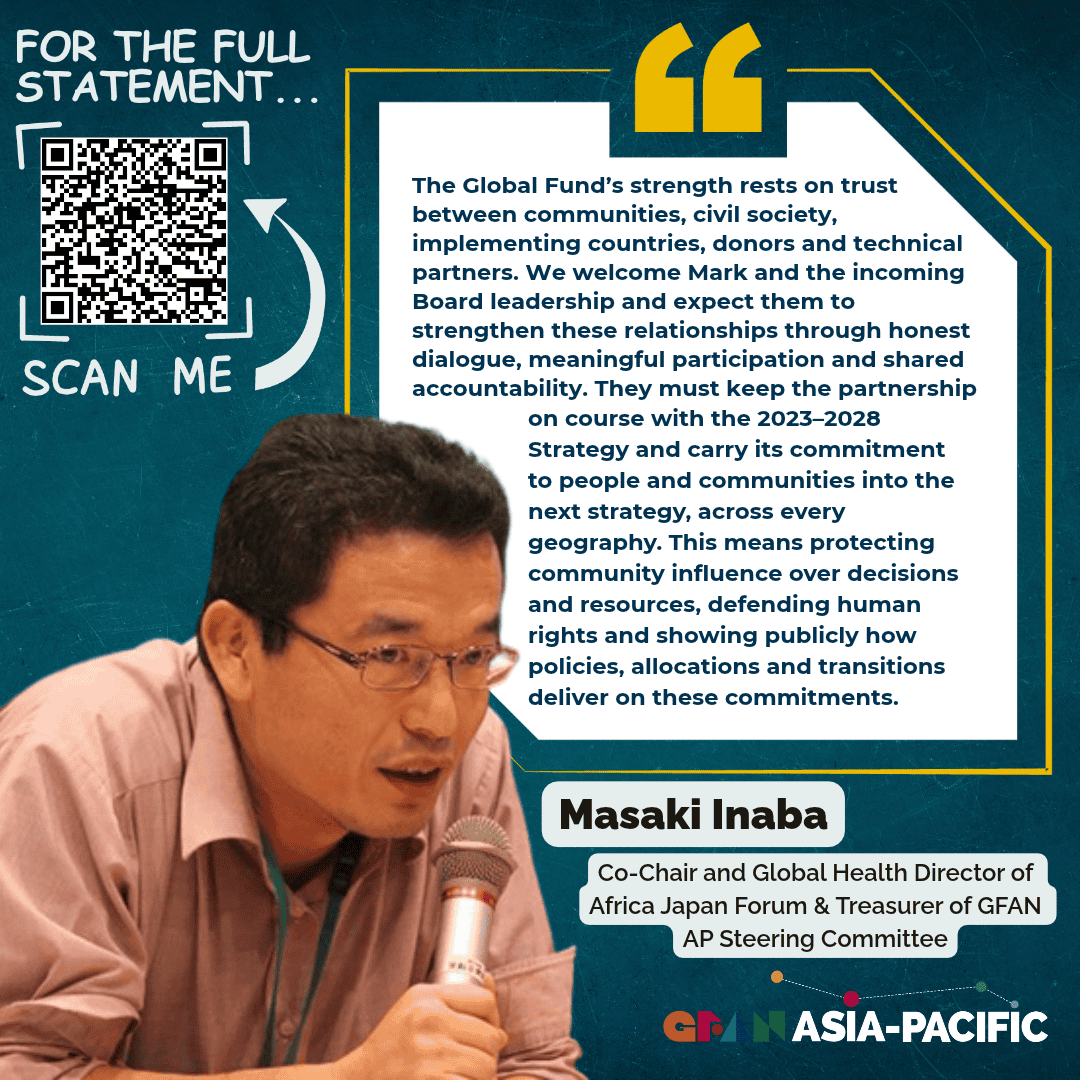
“The Global Fund’s strength rests on trust between communities, civil society, implementing countries, donors and technical partners. We welcome Mark and the incoming Board leadership and expect them to strengthen these relationships through honest dialogue, meaningful participation and shared accountability. They must keep the partnership on course with the 2023–2028 Strategy and carry its commitment to people and communities into the next strategy, across every geography. This means protecting community influence over decisions and resources, defending human rights and showing publicly how policies, allocations and transitions deliver on these commitments,” said Masaki Inaba, Co-Chair and Global Health Director of Africa Japan Forum and Treasurer of GFAN AP Steering Committee.
GFAN AP looks forward to working with the incoming leadership and partners to advance these priorities across Asia-Pacific. Through our networks, we can bring community perspectives and evidence into policy discussions, support advocacy for sustainable financing and facilitate dialogue on implementation challenges and practical solutions. We welcome opportunities to review progress together, with a shared focus on protecting rights, sustaining access to quality care and strengthening communities’ participation in decisions that affect their lives.