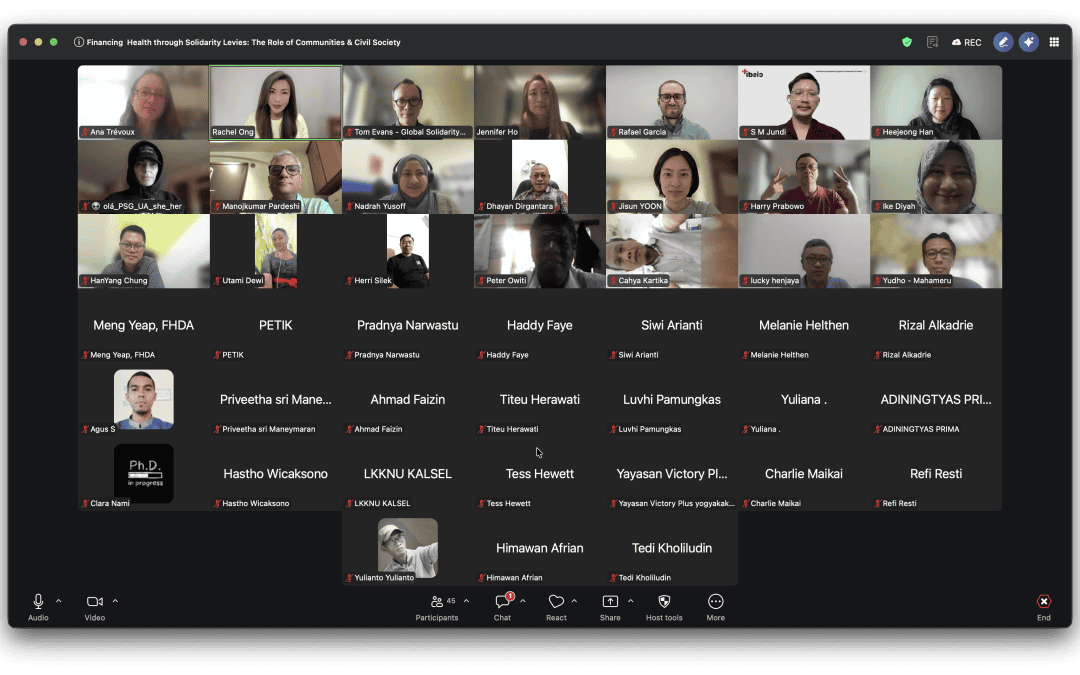
On 22 April 2026, Global Fund Advocates Network Asia-Pacific (GFAN AP), Joep Lange Institute (JLI), Malaysian AIDS Council (MAC), Malaysian AIDS Foundation (MAF), and the Center for Indonesia’s Strategic Development Initiatives (CISDI) jointly hosted the third webinar of a series focused on innovative financing titled “Financing Health through Solidarity Levies: The Role of Communities and Civil Society”. The webinar was attended by approximately 50 participants from Asia Pacific, Africa, and Europe and moderated by Jennifer Ho (Operations and Programmes Manager, GFAN AP).
This webinar series aims to build understanding of innovative financing by providing participants with a clear and accessible explanation of what innovative financing is, how it differs from traditional health financing mechanisms, and why it is relevant in the context of global health, particularly in the Asia-Pacific region. It also aims to showcase practical applications and lessons learned by highlighting real-world examples of innovative financing mechanisms, such as social impact bonds, health taxes, blended finance, and social contracting in the Asia-Pacific region, demonstrating their potential to address health financing challenges and improve health outcomes, while also discussing key lessons and challenges.
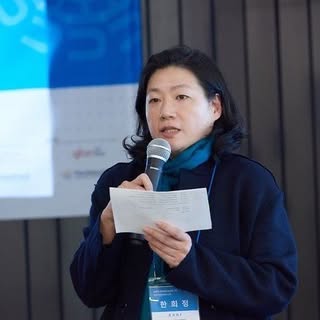
The last of webinar of the series on innovative financing mechanisms, this webinar focused on solidarity levies as a financing mechanism for global and domestic health. Rafael Garcia (Portfolio Manager, Joep Lange Institute Center for Global Health Diplomacy) opened the discussion with an introduction on solidarity levies, which are not entirely new and represent an innovative approach to taxation that promotes global solidarity and addresses cross-border challenges such as climate change and health crises. Ana Trevoux (Advocacy Officer, France and Spain, Friends of the Global Fund Europe) presented France’s experience with solidarity taxes on airline tickets and financial transactions, highlighting how civil society organisations played a crucial role in advocating for these taxes and their allocation towards international development funds. Heejeong Han (Executive Director, Korean Advocates for Global Health) shared South Korea’s journey with their airline ticket solidarity levy, emphasising the critical role of civil society in institutionalising the fund through legal measures. Lastly, Tom Evans (Senior Associate, The Global Solidarity Levies Task Force) outlined the work of the task force, including the launch of the Premium Flyers Solidarity Coalition, which focuses on levies on business and first-class airline travellers, and discussed potential new sources of financing through fossil fuel sector taxes and cryptocurrency levies. The session concluded with a Q&A discussion moderated by Sayyid M. Jundullah (Senior Officer, Health Policy and Community Partnership, Center for Indonesia’s Strategic Development Initiatives) where participants explored challenges and opportunities in advocating for solidarity levies at the national level and the potential for implementation in the Asia-Pacific region for health.
1. What are Solidarity Levies
An overview on Solidarity Levies was provided by Rafael, outlining that solidarity levies are progressive taxes on specific activities (aviation, financial transactions, fossil fuels) designed to generate concessional finance for development and climate action without increasing debt burdens. They operate on the polluter-pays principle, targeting high-emission sectors and wealthy consumers rather than general populations. Over 50 countries globally have implemented some form of aviation levy, demonstrating feasibility. He explained while levies have a long history, their innovative aspect lies in promoting solidarity and addressing challenges that transcend borders. Rafael highlighted the need to change public perception about taxation and discussed the importance of learning from past implementations and exploring new mechanisms to tackle current global challenges, including health, climate, and food security. He encouraged attendees to consider how to engage decision-makers in implementing solidarity levies to address these pressing issues.
2. France’s Solidarity Taxes
Ana presented on France’s solidarity taxes, explaining how they were introduced in 2006 and 2012 to finance global public goods through airline ticket taxes and financial transaction taxes. She detailed how these taxes generated significant revenue but were recently integrated into France’s general budget rather than maintaining direct allocation to the Solidarity Fund for Development (FSD) – an extra-budgetary fund supporting UNITAID, Global Fund, GAVI and other multilateral organisations. The Solidarity Tax on Airline Tickets (TSBA) introduced in 2006 is now generating €1.3 billion annually with a recent increase bringing it to €7 (economy) to €15+ (long-distance) per ticket; the Financial Transaction Tax (FTT) introduced in 2012 generated €1.9 billion in 2023 was also increased in 2025 to a 0.4% tax rate on French company shares. Before 2025, the FSD allocated €738 million per year to 29 organisations with direct, protected funding. Ana emphasised the importance of civil society organisations in advocating for these taxes and highlighted key lessons including the need for legally secure direct allocation, transparent taxation mechanisms, and advocacy primarily at the national level.
However, in 2025, France suspended the FSD’s extra budgetary status due to legal requirements and political reprioritisation, integrating revenues into the general budget where allocations now vary annually based on political decisions. French civil society are now advocating for the restoration of direct allocation through proposed legislation.
3. South Korea’s Global Health Financing
Heejeong presented South Korea’s experience with the Air Ticket Solidarity Levy, explaining how it evolved from a government-driven tax to a permanent legal basis for global health financing through the Global Disease Eradication Fund Act. South Korea launched teh “1,000 Won” airline levy in 2007 (approximately US$1 per ticket, flat rate across all classes) to supplement ODA, creating the Global Disease Eradication Fund (GDEF) in 2017 with legal protections and a civil society seat on the management committee.
The GDEF structure is as follows:
- 40% to multilateral organisations, such as the Global Fund, UNITAID, GAVI
- 40% to multi-stakeholder projects and partnerships, such as UNFPA and UNICEF
- 19% to Korean NGO field projects in Africa
It is to note that 100% of UNITAID and GAVI contributions are derived from the levy, and the majority of Global Fund pledges sourced from GDEF.
She highlighted the crucial role of civil society in advocating to keep the fund focused on global solidarity and described how the fund allocated resources across different global health initiatives and projects. Heejeong noted that while the levy was abolished in 2024 due to taxation system reforms, classifying it as a “quasi-tax” because direct beneficiaries were non-Korean. Since then, civil society have been advocating for a dedicated global health security line item within the general budget to maintain predictable funding for international health initiatives and commitments.
4. Solidarity Levies for Financing Development
The Global Solidarity Levies Task Force (GSLTF) was launched at COP28 in 2023 by Barbados, France and Kenya to build political will for solidarity levies addressing climate and development financing gaps which are estimated in the trillions of dollars. The mandate extends to 2028 following COP30 endorsement. Priority mechanisms explored include fossil fuel sector levies (extraction and windfall profits); maritime emissions pricing (negotiations ongoing at IMO); financial transaction taxes; cryptocurrency capital gains and transaction taxes; and aviation levies – the Premium Flyers Coalition.
Launched June 2024 in Seville with 13 member countries (primarily European and African), the Premium Flyers Coalition targets business, first class, and private jet travellers – the 1% of flyers responsible for half of aviation emissions. The aviation sector has historically been undertaxed as jet fuel is exempted from taxation unlike vehicle fuels, and a progressive approach with minimal demand impact is implemented given that wealthy consumers absorb costs easily. Existing models include Maldives which uses tiered rates and France which charges higher rates for premium classes and global implementation could mobilise over $100 billion annually. Tom pointed out that no country in the Asia-Pacific has joined the coalition which represents key advocacy opportunities.
5. Plenary Discussion
Moderated by Sayyid, the discussion:
- Addressed challenges in engaging governments, with Tom and Ana noting concerns about economic impact and the need for progressive, minimal-impact levies.
- Participants discussed the role of civil society in advocating for solidarity levies and the potential for more engagement of Asia-Pacific countries.
- The Asia-Pacific region has the world’s most populous countries with high potential for levy implementation and could also explore sin taxes that could be channeled toward health programmes/budgets – including exploring diverse levy applications such as motorbike emission levies for populous LMICs with high aggregate emissions, and support national health insurance schemes.
- The conversation ended with a call for continued advocacy and support for innovative financing mechanisms that engage communities and civil society meaningfully given diminishing resources from donors in the Asia-Pacific region and the need for sustainable domestic resource mobilisation at the national levels.
6. Closing Remarks
The webinar concluded with closing remarks and appreciation by Rachel Ong (Regional Coordinator, GFAN AP) to the co-organisers, interpreters, speakers, and participants for an engaging discussion. GFAN AP will continue to support coordination and work with partners to support the initiation and continuation of conversations at the national and community level on innovative financing mechanisms in the Asia-Pacific. Sincere gratitude was expressed to all co-organisors of the webinar series and all participants. GFAN AP will be organising a next installment of webinars that will focus on supporting domestic resource mobilisation efforts at the national level for sustainable health financing in the Asia-Pacific region.
SPEAKERS:

Rafael García Aceves
Portfolio Manager, Joep Lange Institute Center for Global Health Diplomacy



Sayyid M. Jundullah
Senior Officer for Health Policy and Community Partnership
PRESENTATIONS:
- France’s Pioneering Solidarity: The Power of Community and Civil Society Advocacy and Political Leadership. Presenter: Ana Trevoux, Friends of the Fund, Europe
- South Korea’s Airline Levy Journey. Presenter: Heejong Han, KAGH
- Global Solidarity Levies Task Force. Presenter: Tom Evans, Global Solidarity Task Force