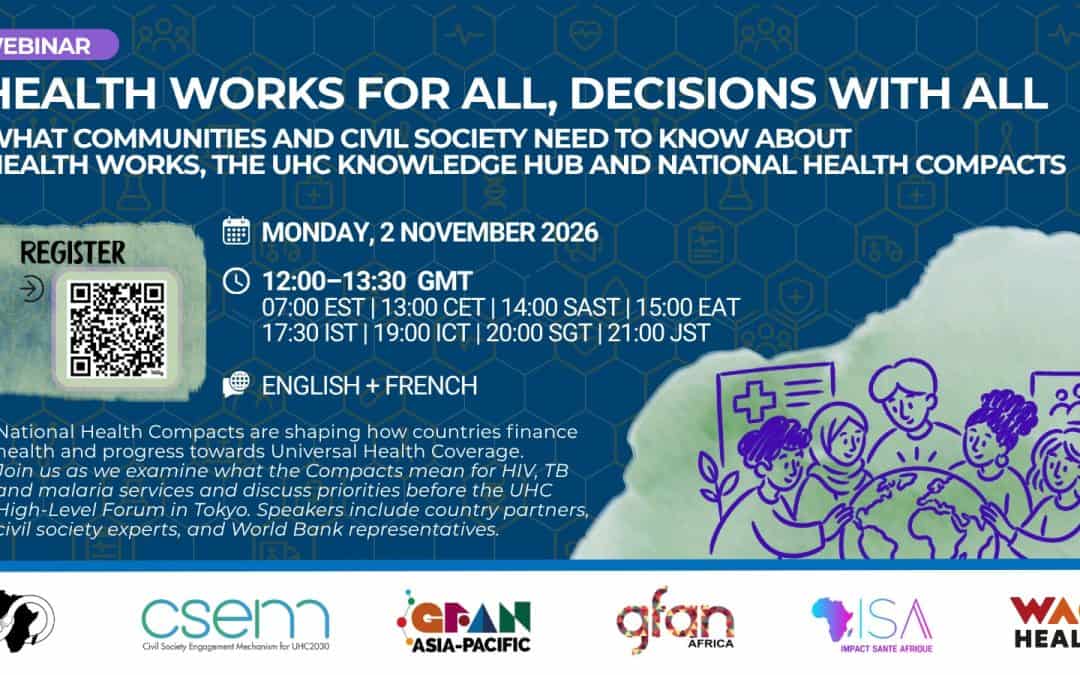
On 2 November 2026, the Global Fund Advocates Network Asia-Pacific (GFAN AP) and partners convened the first webinar in the three-part series, “Health Works for All, Decisions with All.” Bringing together over 90 community and civil society advocates, development partners and institutional representatives from Africa, Asia-Pacific and beyond, the webinar explored how communities can meaningfully influence emerging health financing and Universal Health Coverage (UHC) initiatives.
The webinar was jointly convened by GFAN AP, Africa Japan Forum (AJF), WACI Health, GFAN Africa, Impact Santé Afrique (ISA) and the Civil Society Engagement Mechanism for UHC (CSEM). Jennifer Ho, Operations and Programmes Manager of GFAN AP moderated the session, with Carthi Mannikarottu, Communications Lead of GFAN Africa facilitating the discussion.
Against a backdrop of declining external assistance, pressure on domestic budgets and persistent inequalities in access to care, the session focused on three connected initiatives: Health Works, National Health Compacts and the UHC Knowledge Hub. Each has implications for how countries identify health priorities, mobilise resources and implement reforms. The central question running through the webinar was how communities and civil society can influence those decisions, particularly when financing changes put essential services at risk.
The webinar set out to:
-
-
- Strengthen understanding of the initiatives and their implications for national health financing and reform.
- Examine what is known about community and civil society participation, including progress, gaps and unanswered questions.
- Identify practical opportunities for engagement ahead of the UHC High-Level Forum in Tokyo in December 2026.
-
1. Understanding the Initiatives and Why They Matter for Communities
Waiswa Nkwanga, Coordinator of CSEM, opened the substantive discussion by explaining the relationship between the initiatives and the World Bank’s ambition to support countries in reaching 1.5 billion people with quality, affordable health services by 2030.
Health Works seeks to mobilise political leadership, partnerships and resources around expanding access to health services. National Health Compacts provide country-led frameworks for identifying priority reforms, investment needs and measurable commitments. The UHC Knowledge Hub supports health and finance leaders through technical expertise, peer learning and leadership development. While connected, these initiatives have different functions. Understanding those differences is important for advocates seeking to identify where decisions are made, whom to approach and when their contributions can have the greatest influence.
Waiswa emphasised that communities and civil society bring evidence that institutions need: where people encounter barriers, which populations remain underserved and whether investments are improving access in practice. Their contribution extends from shaping priorities and investment plans to monitoring implementation and holding governments and partners accountable.
He also distinguished between civil society’s potential role and the participation arrangements established so far. Advocacy for meaningful engagement has taken place, including through joint requests to governments and institutions, but participation remains uneven and requires further work.
For countries developing new Compacts, the immediate opportunity is to contribute before priorities and commitments are finalised. Where Compacts already exist, communities can examine implementation, monitor progress and continue to influence investment choices. For the Knowledge Hub, Waiswa called for stronger opportunities to help shape learning programmes and ensure that government participants are equipped to work with communities.
The purpose of engagement is ultimately to ensure that reforms prioritise people furthest behind and respond to the barriers they experience.
2. Moving from Recognition to Meaningful, Institutionalised Participation
Masaki Inaba, Co-Chair of AJF and Chair of the Japan CSO Network on Global Health, examined the institutional landscape and Japan’s role.
He highlighted the different responsibilities and leadership arrangements across the initiatives. The service coverage target is a World Bank institutional target; National Health Compacts are country-led reform frameworks supported by the Bank; and the Knowledge Hub has strong Japanese support, with implementation involving the World Bank and WHO. The Health Works Leaders Coalition and UHC High-Level Forum help convene stakeholders and mobilise political commitments.
Masaki raised questions about how these components fit together, who is accountable for their ambitions and how civil society can participate as an equal partner. He also sought greater clarity on WHO’s role and on governance across the wider Health Works landscape.
His presentation connected these questions to financing. He described links between national reforms, concessional lending, co-financing and private-sector engagement, illustrating why advocates need to understand how priorities translate into investment decisions. As these arrangements develop, communities need opportunities to scrutinise what is financed and whether reforms sustain equitable access.
Masaki’s broader message was that civil society should engage systematically as these initiatives evolve and influence health financing beyond 2030.
Jennifer Ho reinforced the distinction between recognising participation in principle and making it meaningful in practice. Relevant questions include:
-
-
- Timing: Are communities involved while priorities and investments can still change?
- Representation: Who participates, and whose experiences remain absent?
- Resources: Can community organisations participate without financial or practical barriers?
- Influence: Is there a clear explanation of how recommendations affect decisions?
-
These questions provided a framework for assessing the institutional presentations and country experiences that followed.
3. Institutional Perspectives: Connecting Priorities, Financing and Implementation
National Health Compacts as a bridge between health and finance
Patrick Quigley, Strategy and Partnerships, of the World Bank explained that Compacts respond to countries’ interest in setting focused reform priorities and protecting health within broader development agendas, particularly amid reductions in development assistance.
He described Compacts as a bridge between ministries of health and finance: a way to connect policy intentions with budget decisions and align government and partner support around shared milestones.
Patrick clarified that Compacts are not a prerequisite for World Bank lending or policy dialogue. The Bank sees them as a tool to advance reform and improve alignment, rather than a condition countries must fulfil to access its financing.
He identified several lessons from the initial experience:
-
-
- Mutual commitments should make clear what governments will deliver, what support partners will provide and who is responsible.
- Joint leadership by health and finance ministries helps connect reform priorities with resources.
- Early involvement of civil society and other partners can improve coherence and reduce duplication.
- Specific milestones and strong tracking arrangements support implementation and accountability.
-
Examples illustrated the diversity of country priorities. Patrick referred to primary health care access within five kilometres in Sierra Leone and the expansion of digital primary health care through links between facilities and hospitals in Indonesia.
He also shared a provisional list of countries expected to announce Compacts at the December Forum, including Cameroon, Senegal, Ghana, Tanzania, Armenia, Honduras, Colombia, Paraguay and Pakistan. He stressed that the list remained subject to change. For advocates in those countries, the discussion highlighted the importance of seeking engagement while development processes were still underway.
Participation throughout the Compact Cycle
Patrick outlined opportunities for civil society during preparation, analysis, consultation and implementation.
These included representation in technical working groups, providing community evidence on access and service quality, commenting on draft texts, participating in implementation groups and helping shape monitoring and evaluation.
He emphasised the value of evidence from communities and sources that may otherwise be difficult for institutions to reach. Participation in implementation and tracking was presented as at least as important as involvement in the initial design.
Patrick also acknowledged that the initiatives remain works in progress and that inclusive engagement is not occurring consistently across countries. This acknowledgement created space for discussion about how participation could become more dependable.
The UHC Knowledge Hub: reform capacity and broader partnerships
Hnin Hnin Pyne, Senior Health Specialist and Task Team Leader of the World Bank explained that the Knowledge Hub provides a 12-month capacity development programme focused on health financing reforms.
Its approach extends beyond technical training. It connects health and finance leaders with global expertise, peer-country experience and leadership development, including the ability to work across institutional boundaries and with wider stakeholders.
Hnin Hnin emphasised that the programme’s value depends on what happens at country level: whether reforms advance and whether partnerships broaden as implementation develops. Drawing on Nigeria, she described how public financial management reforms required engagement beyond federal authorities, particularly with subnational actors.
Her presentation recognised the importance of civil society within these broader partnerships. The specific arrangements through which communities could contribute to the Hub’s design, delivery and review, however, remained an area requiring further clarification.
4. Country Perspectives: Protecting Services, Participation and Financial Protection
Kenya: Building on existing capacity and making financing responsibilities explicit
Dr Githuka George, Programme Director for Disease Control and Prevention Management at Amref Health Africa in Kenya, shared lessons from health financing, devolved service delivery and community engagement.
He explained that Kenya’s national and county governments have different responsibilities. National authorities shape policy, legislation and financing arrangements, while counties play central roles in implementation, staffing and community health services. Effective engagement therefore needs to reach both levels.
Dr Githuka stressed that communities are not starting from scratch. Global Fund processes have supported civil society capacity through grant development, implementation and oversight. Community constituency representation and community-led monitoring offer experience that can inform engagement with broader health reforms.
He also described public participation opportunities through sector hearings, budget policy processes, parliamentary scrutiny and county-level planning. These provide routes for communities to raise specific financing needs, including TB commodities, laboratory capacity, staff, outreach, transport and referral support.
Using the TB care pathway, he illustrated why financing responsibilities need to be explicit. Community outreach, diagnosis, treatment and follow-up may depend on different combinations of partner funding, national programmes, county services and community structures. Maintaining continuity requires clarity about who pays for each component and how responsibilities change during transition.
Practical lessons included transparent programme costs, alignment with government-approved rates and coordination between partner funding timelines and public budget cycles. These arrangements can make it easier for governments to plan for and absorb costs.
For Dr Githuka, Compacts could make four issues clearer: who decides, how communities influence choices, who finances services and who reports back or addresses gaps. He also acknowledged that scrutiny of expenditure remains challenging, even where civil society can review allocations.
Morocco: Insurance enrolment must translate into effective access
Zakaria Bahtout, Programme Manager at ITPC-MENA, presented Morocco’s experience and examined what national reforms mean for people needing HIV, TB and malaria services.
His central message was that insurance enrolment does not automatically provide effective access or financial protection. People may remain unable to obtain care because of direct payments, medicine costs and other barriers, even as coverage expands.
Zakaria described a Compact focused on financial protection, infrastructure, health personnel and the private sector. He then examined what remained less explicit: the place of community organisations, the continuity of disease-related services and the mechanisms for participation.
He reported that his organisation had not been invited into the Compact discussions. In his review of the document, civil society appeared in a general list of partners, without a clear consultation process, participation timetable or feedback mechanism.
He presented this as a gap requiring attention, rather than an accusation. The distinction was important: the concern was whether communities could identify a reliable route into decisions and understand how their contributions would be considered.
Zakaria also highlighted the limited visibility of HIV, TB and malaria in the Compact. His presentation raised the question of whether these responses would be deliberately sustained within broader reforms, including community testing, outreach, treatment support and services for key populations.
These concerns were particularly relevant to financing transition. Changes in external support could put community functions at risk unless their financing, delivery and accountability arrangements were addressed explicitly.
He proposed five practical measures:
-
- Publish participation records: Identify who was consulted, on which version, at what stage and what changed as a result.
- Provide a civil society seat in Compact governance: Establish transparent selection, support participation and publish feedback.
- Map resources and financing gaps: Include domestic and external resources, including relevant Global Fund support.
- Create legal and budgetary routes for community services: Enable public financing and contracting of community-led HIV, TB and malaria services.
- Institutionalise responses to community-led monitoring: Identify who must respond, within what timeframe and how corrective action will be reported.
These proposals linked participation to decisions about resources and service continuity, making community engagement relevant throughout the reform process.
5. Discussion: Clarifications, Practical Offers and Questions Still Open
The discussion facilitated by Carthi Mannikarottu explored how these ambitions would operate in practice. Questions from participants addressed policy coherence, access to decision-making, transparency and the responsibilities of institutions when participation falls short.
How do Compacts fit with existing strategies and commitments?
Participants asked whether Compacts could duplicate or weaken existing national health strategies. They also sought clarification on links with Accra Reset, commitments from the UN High-Level Meeting on UHC, Global Fund financing and other development banks.
Patrick explained that countries determine the scope of their Compacts and that these may overlap with national health strategies, particularly where planning cycles align. He highlighted focused reforms, quantified targets and milestones as useful features of the Compact approach.
This clarified the flexibility of the model. However, the specific relationships with Accra Reset, UN commitments and the different financing institutions were not fully explained during the exchange. Further clarification would help advocates understand how these processes connect and which commitments they can use to track progress.
What happens when communities cannot access the process?
Zakaria’s account prompted a question about more difficult settings: if participation remains limited in a country with comparatively favourable conditions, what support is available where civic space, institutional access or security conditions present greater barriers?
Patrick reiterated the importance of country-specific approaches and offered to facilitate introductions to World Bank country teams. He cited an example of connections already facilitated between the GFF and civil society organisations in Pakistan.
This was a practical offer that participants could take up immediately. It did not, however, fully address whether participation would be formally required, what minimum arrangements would apply or what recourse communities would have if introductions did not lead to meaningful engagement.
The exchange therefore distinguished between assistance in opening a conversation and the more durable arrangements needed to sustain participation.
Will participation and accountability be documented?
Questions in the chat made these concerns more specific. Participants asked whether Compacts would include publicly accessible targets, budgets and progress reports, alongside mechanisms for communities to monitor implementation and raise concerns.
One proposal was for a mandatory stakeholder-engagement annex recording participants, consultation timelines and responses to contributions. Another suggested a participation scorecard to make engagement more visible and comparable.
Patrick supported transparency and described the value of measurable commitments and monitoring. He also shared the repository of published Compacts. The session did not establish whether the proposed annex, scorecard or other common participation requirements would be adopted.
These remained proposals for further consideration, rather than agreed institutional commitments. Their relevance lay in making participation observable: who was involved, what influence they had and what happens when gaps are identified.
What are the concrete entry points into the Knowledge Hub?
Participants asked for two or three specific ways civil society could contribute to the Hub and whether formal mechanisms already existed.
As Hnin Hnin had needed to leave for another call, Patrick offered to share her contact information and facilitate further clarification. He encouraged engagement at national level and reiterated the willingness to help identify relevant contacts.
This provided a route for follow-up, while leaving the detailed arrangements for participation unresolved. Opportunities to contribute to programme design, delivery, review and relevant advisory or technical processes still required explanation.
Jennifer’s earlier distinction remained useful: advocates need to know which opportunities already exist and which are still being developed.
Recognising faith-based providers as strategic stakeholders
Participants also asked how faith-based health organisations could be engaged beyond their role as service providers, including in national financing policies and decisions.
Dr Githuka described Kenya’s experience of working through faith-based umbrella bodies. These structures support engagement with national and county governments, coordination with partners, access to diagnostic and treatment commodities and links with primary health care services.
His examples demonstrated how existing representative structures can support dialogue and coordination. They offered a practical country experience, while the broader question of consistent participation across the new initiatives remained relevant.
Across the discussion, there was recognition of the importance of community involvement. The unresolved issues concerned how that recognition would translate into clear responsibilities, accessible processes, resources and sustained influence. Some responses clarified the initiatives; others identified possible opportunities or deferred detailed answers to follow-up. Continued dialogue will be important, alongside evidence of how these arrangements work in countries.
6. From Dialogue to Action Ahead of the Tokyo Forum
Closing the webinar, Rachel Ong, Regional Coordinator of GFAN AP, emphasised that country ownership must include the people whose health and lives are affected by decisions.
Participation needs to begin while priorities and investments are being shaped and continue through implementation, monitoring and review. It requires access to information, resources to participate and a clear response explaining how community recommendations influence decisions.
Rachel outlined three areas for immediate action:
-
-
- Engage with National Health Compacts. Request documents, implementation arrangements, financing commitments and opportunities to review progress. Where a new Compact is being developed, seek involvement before priorities are finalised.
- Help shape the UHC Knowledge Hub. Seek clarification and opportunities to contribute to the programme’s design, delivery and review.
- Build collective advocacy for the Tokyo Forum. Document outreach, including whom organisations contact, the responses received and unresolved issues. Share examples of both effective engagement and barriers with the organising partners.
-
The second webinar, scheduled for 26 November 2026 (register here), will draw on these experiences to refine concrete advocacy asks and identify who will take them forward before the December Forum.
The first session strengthened understanding of the initiatives and identified practical routes for engagement. It also showed why institutional follow-up matters. Clearer information on participation mechanisms, financing responsibilities and responses to exclusion will help communities assess whether the opportunities described lead to influence over decisions.
For communities navigating financing transitions, that influence has direct consequences: whether essential services continue, whether community organisations can sustain their work and whether people can obtain care without financial hardship.
Moderators:


Speakers:
Waiswa Nkwanga
Senior Technical Advisor, UHC, and Coordinator of CSEM



Dr Githuka George
Programme Director, Disease Control & Prevention Management


PRESENTATIONS:
- Health Works for All, Decisions with All. Presenter: Waiswa Nkwanga, CSEM
- Health Works: What we know and what we want. Presenter: Masaki Inaba, AJF
- Making Health Compacts Work for Communities. Presenter: Dr Githuka George, Amref Health Africa in Kenya
- From the right to coverage to effective access. Du droit à la couverture à l’accès effectif. Presenter: Zakaria Bahtout, ITPC-MENA