As governments, development partners and global health institutions shape new approaches to health financing and Universal Health Coverage (UHC), communities and civil society need more than an invitation to the conversation. We need a meaningful role in shaping priorities, budgets and accountability.
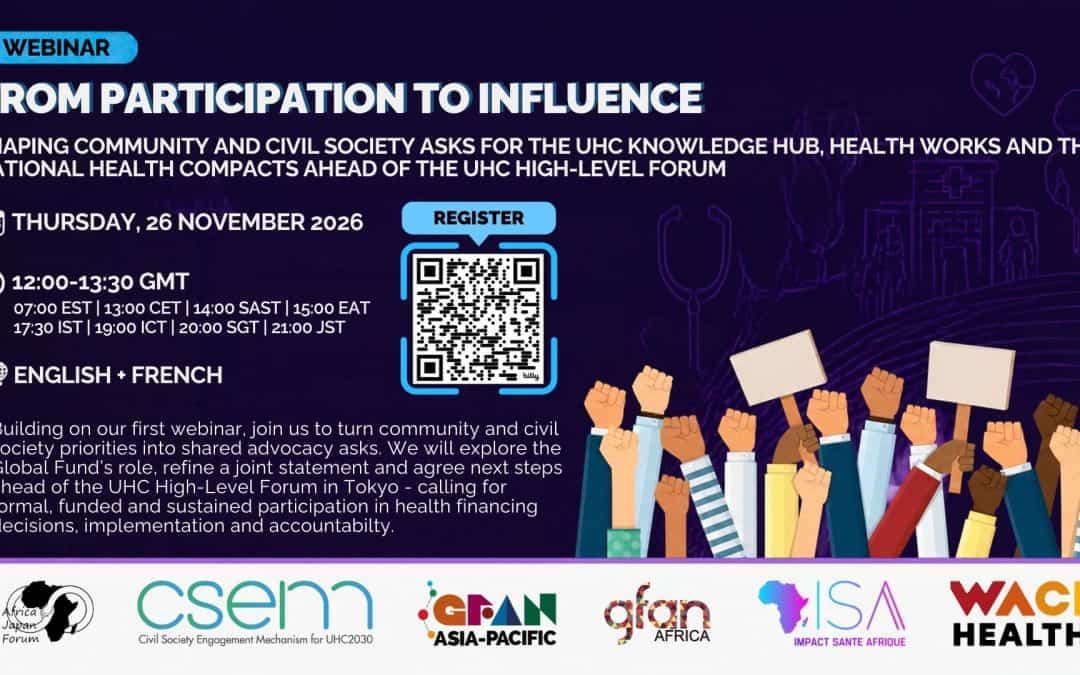
On 26 November 2026, the Global Fund Advocates Network Asia-Pacific (GFAN AP) and partners convened the second webinar in the three-part series, “Health Works for All, Decisions with All.” Titled “From Participation to Influence: Shaping Community and Civil Society Asks for the UHC Knowledge Hub, Health Works, and National Health Compacts Ahead of the UHC High-Level Forum,” the session built on the first webinar’s overview of these initiatives and turned to the practical question of how communities and civil society can influence them. The second session also focused on refining collective advocacy messages based on inputs and comments from the first webinar ahead of the UHC High-Level Forum in Tokyo in December.
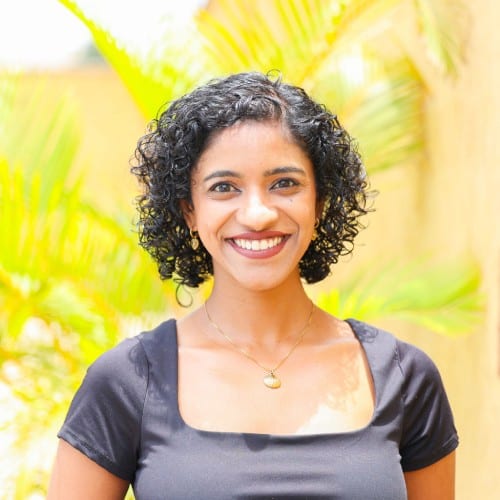
The webinar was jointly convened by GFAN AP, Africa Japan Forum (AJF), WACI Health, GFAN Africa, Impact Santé Afrique (ISA) and the Civil Society Engagement Mechanism for UHC (CSEM). Jennifer Ho, Operations and Programmes Manager of GFAN AP moderated the session, with Carthi Mannikarottu, Communications Lead of GFAN Africa and WACI Health facilitating the discussion.
Turning participation into influence
The initiatives under discussion could shape how countries set health priorities, coordinate partners and finance reforms. Health Works brings political leadership and partners together around UHC goals; National Health Compacts set out country priorities and commitments; and the UHC Knowledge Hub supports health and finance officials through technical assistance, peer learning and leadership development.
For communities and civil society, the central test is whether these processes improve people’s access to affordable, continuous and equitable services. A plan alone cannot guarantee that services are funded, providers can deliver them, or people facing stigma, discrimination and financial barriers can reach care. As financing responsibilities shift, communities and civil society must be able to influence decisions before they are made and track what happens afterwards.
Mapping the initiatives and where communities can influence them
Carthi Mannikarottu of WACI Health and GFAN Africa opened the recap by returning to the first webinar on 2 November, which brought together more than 90 participants from Africa, Asia-Pacific and beyond. That discussion asked what communities and civil society need to understand in order to engage with Health Works, National Health Compacts and the UHC Knowledge Hub. Carthi explained how the initiatives connect: Health Works brings political leadership and partners together around shared health goals; National Health Compacts set out country priorities, reforms and commitments; and the Knowledge Hub supports health and finance officials through technical assistance, peer learning and leadership development. Understanding those different roles, she stressed, helps identify where decisions are made and where communities can engage.
Her recap also highlighted lessons from the first wave of National Health Compacts. Early civil society engagement can make plans more coherent and reduce duplication, while clear milestones and follow-up can strengthen implementation and accountability. Carthi outlined practical entry points for civil society: seek representation in technical working groups, contribute community evidence on access and service quality, comment on draft compact texts, and participate in implementation groups. Where engagement with a national government is not progressing, she noted that civil society could also seek support from the World Bank’s global team.
Country examples showed why these opportunities matter. In Kenya, a compact needs to make clear who will finance each step of care, including testing, diagnosis, treatment and follow-up for tuberculosis. When funding changes, services can be lost if responsibility for a step is unclear. Existing Global Fund processes and Kenya’s constitutional provisions for public participation can provide routes for communities to contribute to national and county budget discussions.
The Morocco example underscored that formal coverage does not necessarily mean people can access care. Carthi cited figures shared in the recap indicating that, despite high health-insurance enrolment, a significant share of people still lacked effective access. She also noted that civil society appeared in the draft compact as a partner without a clear consultation process or feedback mechanism, while HIV, tuberculosis and malaria received limited attention despite ongoing financing challenges. Taken together, the examples made a practical case for community participation throughout planning, financing and accountability—not only when a compact is launched.
Financing reform must be country-led and inclusive
Matthew MacGregor, Head of the Health Finance Department at the Global Fund, welcomed Health Works’ ambition to help extend quality, affordable health services to 1.5 billion more people by 2030. He describe the initiative as an opportunity to bring health and development partners together at a time of pressure on external financing and growing attention to sustainability and transitions. The Global Fund joined the coalition early, he said, because financing challenges cannot be solved by partners working in separate silos.
MacGregor highlighted the UHC Knowledge Hub’s potential to strengthen coordination between ministries of health and finance. Capacity-building for policymakers can help them address bottlenecks and become stronger advocates for health investment. But the Hub’s success will depend on whether learning at the global level leads to practical reforms in countries.
He pointed to existing Global Fund work that could support this shift: health-financing dialogues with the African Union, co-financing efforts that help countries gradually and deliberately reduce reliance on Global Fund resources for critical interventions, and investments in public financial management. The latter can strengthen how governments plan, budget, execute and oversee both external grants and domestic spending, and help integrate financing into national budgets.
MacGregor described National Health Compacts as a possible platform for “one plan, one budget, one reporting mechanism,” provided they are genuinely country-led, cover all health priorities, connect to domestic budget processes and involve partners―including communities and civil society―from the outset. He noted that the Global Fund is adapting its own work to support HIV, TB and malaria responses in more integrated and sustainable ways, including through primary health-care platforms and unified health systems. Compacts could help align partners around country priorities, but should preserve attention to diseases and services that remain heavily dependent on external financing.
He emphasised why civil society and communities belong throughout the process: they can identify who is not accessing services, why people leave care, and how discrimination or user fees create barriers—information that formal systems may not capture. Communities also often reach people that public services miss. Their role should extend across priority-setting, financing, implementation and accountability.
At the same time, MacGregor stressed that community engagement does not replace government leadership. Governments must lead national strategies and financing reforms, while public institutions and community systems work together. In his view, these are complementary parts of a stronger health response.
In the discussion that followed, he reiterated that Global Fund investments in health workers, surveillance, primary care and community systems can support outcomes beyond HIV, TB and malaria, while the unfinished work on these diseases remains urgent. He also supported treating multilateral development bank financing as a complement to grants. Lending can add resources, but grants remain essential for low-income contexts, particular populations and interventions; any move away from grant financing needs to be responsible and gradual.
Widen the space for communities an civil society at the UHC High-Level Forum
Masaki Inaba, co-chair of Africa Japan Forum, chair of the Japan CSO Network on Global Health and Treasurer of GFAN AP Steering Committee, shared an update on the UHC High-Level Forum planned for Tokyo. He cautioned that the agenda he presented was based on information from unofficial sources and could still change.
The draft agenda described a half-day event with high-level sessions on the first and second cohorts of the UHC Knowledge Hub, followed by a technical session on the Hub and National Health Compacts. Inaba said the schedule appeared to give more attention to the Knowledge Hub than to the Compacts, even though Compacts could have a direct influence on national health financing. He also raised concerns that the forum was invitation-only and, as described in the draft, offered little opportunity for interactive exchange or questions from participants.
Inaba noted that the forum’s stated purpose was to build political commitment among participating countries and encourage greater investment in health. He argued that shortcomings in the forum’s format should not weaken wider advocacy for Health Works. Civil society, he said, would need to keep engaging through other routes, including country-level advocacy, regional and global coordination, and opportunities around the World Bank and IMF Spring and Annual Meetings.
He also described progress in opening the forum to civil society. Initial plans had included only two civil society organizations. Following advocacy by Japanese and international groups, the participation plan had expanded to five international civil society representatives and five Japanese advocates. Inaba outlined planned civil society activities around the forum: a strategy meeting on 10 December, a stakeholder dialogue on 11 December and follow-up engagement after the forum. He framed this as progress, while emphasizing the need for sustained coordination and advocacy beyond a single event.
Young people want to shape and implement UHC
Salome Da Silva Duarte Lepez (DSDL), who goes by Sam, spoke on behalf of the WHO Youth Council as head of delegation for the UHC High-Level Meeting in Tokyo. She described young people as co-creators and co-implementers of health systems, with practical experience from community and multilateral work. Youth organizations, she said, can help identify service bottlenecks and connect policy discussions with what communities experience.
A consultation survey was still underway when she spoke, but had already gathered perspectives from young people and youth groups in more than 21 countries. Salome summarized five practical recommendations:
-
- Dedicated seats for young people in local UHC design processes and in transparent, time-bound accountability mechanisms.
- Local co-solutioning, with local agencies supporting youth-led initiatives that contribute to shared health goals.
- Ongoing intergenerational dialogue to track implementation, address emerging problems and support mutual learning.
- Mentorship and leadership development linking young people with health and finance ministries and preparing future UHC leaders.
- Dedicated support for participation, so young people can access these opportunities equitably.
Her central point was that youth representation should lead to influence over design, implementation and improvement—not simply a place in the room. Young people will inherit the policies and institutions being built now, and systems that exclude their perspectives risk failing to reflect the needs of current and future generations. She invited partners to work with youth networks and use the survey’s developing findings to strengthen the recommendations.
Four connected advocacy priorities
Rachel Ong, Regional Coordinator of GFAN AP, presented four proposed areas for the collective advocacy statement. Participants were invited to strengthen and refine the asks.
1. Meaningful participation in decisions. Communities and civil society should have formal roles in relevant technical and governance processes, with transparent ways to select representatives. Grassroots organizations and people most affected by barriers to care must be included. Participation needs accessible information, time to prepare, interpretation and support for travel and other costs. Decision-makers should report who was consulted, what they recommended and how their input influenced the final decisions.
2. Financing that is aligned and transparent. National Health Compacts should connect clearly with UHC commitments, Global Fund grants and other domestic and external financing. Mapping resources against compact priorities can reveal what is funded, where gaps remain and which institution is responsible for addressing them. Participants emphasised the need for clarity about how the different plans and financing arrangements fit together.
3. Safe transitions that protect continuity of services. Transition plans should be costed and developed with the communities affected. They should specify who will finance each service and community function, when funding will be available and what will happen if domestic resources are delayed. Community-led organizations play important roles in outreach, prevention, diagnosis, treatment, support and follow-up. In TB, HIV and malaria responses, continuity depends on trusted community connections as well as medicines and facilities. When a transition timetable puts services at risk, it should be reviewed.
4. Transparency and accountability that lead to action. Compact priorities, targets, budgets, funding sources and progress reports should be public and understandable. Communities need clear channels to raise concerns, receive responses and track corrective action. Community-led monitoring and disaggregated data can show who is being missed and why, but evidence must lead to a response. Communities and civil society should also help shape the Knowledge Hub’s learning agenda and see how that learning informs decisions in countries.
UHC means closing the gaps as well as protecting progress
In the discussion, Joanna Laurson-Doube of the NCD Alliance urged participants to frame the advocacy around both protecting existing services and addressing major gaps in health coverage. She highlighted that noncommunicable diseases account for a substantial share of the global disease burden and cautioned against allowing a focus on existing global health initiatives to leave other pressing needs out of view.
Rosemary Mburu of WACI Health called for minimum participation standards across national and international policy processes: dedicated civil society seats, an institutional process through which communities and civil society select their own representatives, and a formal route for their perspectives to shape the country position. A country position, she emphasized, needs to reflect more than the government’s view alone.
From shared asks to follow-through
The closing discussion made clear that the advocacy statement was still a working document. Participants had more questions than answers, including how National Health Compacts would relate to existing national plans, Global Fund grants and other financing arrangements. Jennifer invited the group to identify what they wanted governments, Japan, the World Bank and WHO to address—and what civil society needed to ask of itself to clarify the issues and work together. The exchange also surfaced a concern raised earlier in the webinar: protecting existing services must go hand in hand with addressing gaps that current plans may leave out.
The organizers committed to circulate the draft statement for further input. Country partners would be asked to bring forward their national perspectives and recommendations, and to share the emerging asks with representatives and advisers attending the Tokyo forum. The aim is to make the statement actionable: specify what should change, who should act and how progress can be assessed. After the forum, GFAN AP and partners intend to carry these asks into discussions with health and finance ministries, World Bank country teams and relevant Global Fund structures.
Participants also stressed that follow-through requires institutions to make participation possible in practice. Communities need clear, formal and adequately resourced roles in compact processes, along with access to information and a way to see how their recommendations affected decisions. This matters especially where civic space is shrinking, organizations face restrictions or funding is uncertain. Community groups must remain connected across countries and regions—sharing information, documenting experience and coordinating advocacy—while institutions take responsibility for opening and resourcing the process. Access to decision-making should not depend on personal connections or an invitation that may never arrive.
The group planned to remain connected beyond the Tokyo forum. A third webinar was proposed for the third week of January, after the holiday break, to brief participants and colleagues who could not join the session on what happened at the forum and consider the next steps. The closing message was that participation must continue through the full cycle: shaping priorities, influencing financing, monitoring implementation and holding decision-makers accountable.
For the co-organisors of the webinar series, the measure of success is not simply whether communities are present in the room. It is whether their participation helps protect access, sustain community-led services and monitoring and shape decisions that affect people’s health. Health works for all only when decisions are made with all.
Moderators:

Speakers:


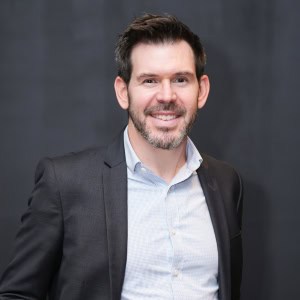
Matthew MacGregor
Head of the health Finance Department


PRESENTATIONS:
- Recap of Webinar #1. Presenter: Carthi Mannikarottu, WACI Health
- Updates on UHC HLF and engagement pathways. Presenter: Masaki Inaba, AJF
- Communities & CS Asks for Input. Presenter: Rachel Ong, GFAN AP